
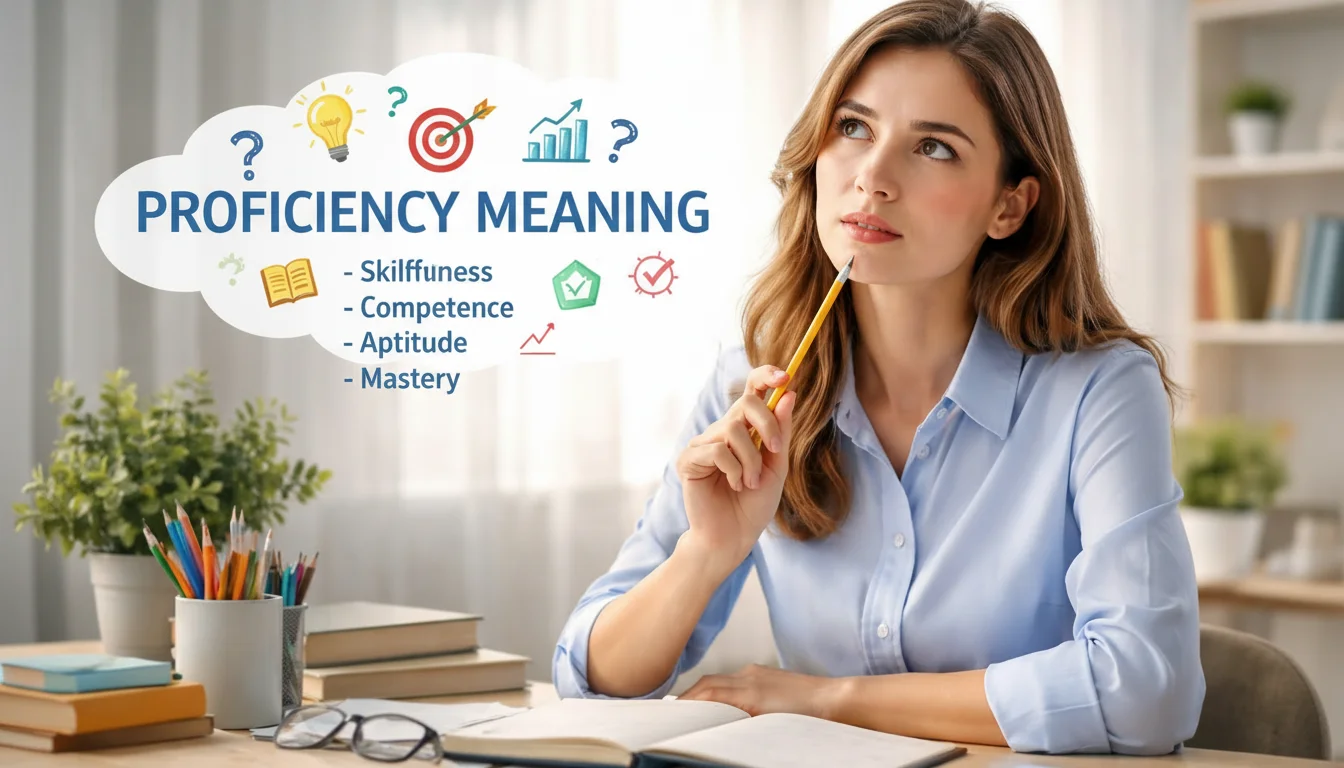

Good Proficiency Meaning
Good proficiency means having a high level of skill, competence, or ability in a particular subject, language, task, or activity.
A person with good proficiency can:
- Perform tasks effectively
- Apply knowledge confidently
- Work with minimal supervision
- Demonstrate strong understanding and expertise
Example:
- “She has good proficiency in Microsoft Excel.”
- Meaning: She can use Excel skillfully and efficiently.
Proficiency Meaning in English
In English, proficiency means:
A high degree of skill, competence, or expertise in a particular area.
The word is commonly used to describe someone’s ability in:
- Languages
- Education
- Sports
- Technology
- Professional skills
Example:
- “His proficiency in English helped him secure the job.”
Skill Proficiency Meaning
Skill proficiency refers to the level of competence a person has in performing a specific skill.
Organizations often measure proficiency levels such as:
- Beginner
- Basic
- Intermediate
- Proficient
- Advanced
- Expert
Examples:
- Programming proficiency
- Communication proficiency
- Leadership proficiency
- Technical proficiency
The higher the proficiency, the better a person can perform the skill.
Proficiency Synonym
Common synonyms for proficiency include:
- Competence
- Expertise
- Skill
- Ability
- Mastery
- Capability
- Aptitude
- Knowledge
Example:
- “Her proficiency in mathematics is impressive.”
- Synonym: “Her expertise in mathematics is impressive.”
Proficiency Meaning in Education
In education, proficiency refers to achieving a required or expected level of knowledge and skills in a subject.
Educational proficiency may be measured through:
- Exams
- Assessments
- Standardized tests
- Classroom performance
Example:
- “Students must demonstrate reading proficiency before graduation.”
Schools use proficiency standards to evaluate academic progress.
Proficiency Meaning in Chinese
In Chinese, proficiency is commonly translated as:
熟练程度 (Shúliàn Chéngdù)
Other related translations include:
- 熟练 (Shúliàn) = Skilled, proficient
- 精通 (Jīngtōng) = Mastery, expert knowledge
Examples:
- English proficiency = 英语熟练程度
- Language proficiency = 语言能力
Lack of Proficiency Meaning
Lack of proficiency means insufficient skill, knowledge, or competence in a particular area.
Examples:
- Lack of language proficiency
- Lack of technical proficiency
- Lack of computer proficiency
Example sentence:
- “The employee required additional training due to a lack of proficiency in the software.”
It indicates that a person has not yet reached the desired level of ability.
Proficiency Meaning in D&D
In the role-playing game Dungeons & Dragons (commonly abbreviated as D&D), proficiency represents a character’s training and expertise in specific areas.
A character may gain proficiency in:
- Skills
- Weapons
- Armor
- Saving throws
- Tools
Being proficient allows players to add their proficiency bonus to certain rolls, increasing their chances of success.
Example:
- A character proficient in Stealth adds their proficiency bonus when making Stealth checks.
Summary
Proficiency means having a high level of skill, competence, or expertise in a particular subject or activity. It is commonly used in education, language learning, professional development, and gaming. Good proficiency indicates strong ability, while a lack of proficiency suggests that additional learning or practice may be needed.

What Does “Proficiency Meaning” Mean in Chat or Text?
Clear Definition
Proficiency means a high level of skill or competence in something.
In simple words:
If you have proficiency in something → you’re good at it.
If someone lacks proficiency → they’re still learning.
Example:
“She has proficiency in Spanish.”
Meaning: She speaks Spanish very well.
Different Meanings Based on Context
The meaning stays the same, but the area changes.
1. Language Proficiency
“English proficiency required.”
Means: You must speak/read/write English well.
2. Job Skills
“Proficiency in Excel.”
Means: You know how to use Excel confidently.
3. Gaming Context
“Weapon proficiency unlocked.”
Means: You’ve gained skill level with that weapon.
4. Academic Setting
“Students must demonstrate math proficiency.”
Means: Show strong ability in math.
So if you’re asking what does proficiency mean in text, it simply refers to skill level — usually high skill.
Brief Origin of the Word “Proficiency”
Proficiency comes from the Latin word proficere, meaning “to make progress.”
It entered English centuries ago and has always referred to skill and advancement.
Unlike internet abbreviations like OTW or BRB, proficiency is traditional vocabulary — often used in:
Education
Professional environments
Certification exams
Government documents
But today, it’s also common in online bios and LinkedIn summaries.

How People Use “Proficiency Meaning” in Real Conversations
Let’s talk practical usage — the way it appears in everyday life.
Platforms Where You’ll See It
You’ll commonly find proficiency on:
Job applications
LinkedIn profiles
CVs and resumes
College forms
Language tests (IELTS, TOEFL, etc.)
Gaming interfaces
Skill-based apps
It’s not common in casual Snapchat chats unless someone is joking.
When It’s Appropriate vs Awkward
Appropriate:
Professional emails
Academic writing
Skill descriptions
Formal introductions
Online profiles
Example:
“I have proficiency in graphic design.”
Awkward:
Casual friend texting
Dating apps (unless discussing skills)
Meme conversations
Saying:
“I have texting proficiency.”
Sounds robotic in casual chat.
Casual Explanation With Real-Life Insight
Here’s the real-world breakdown:
People use proficiency when they want to:
Sound professional
Highlight expertise
Show competence
Meet formal requirements
Instead of saying:
“I’m good at coding.”
They say:
“I have proficiency in Python.”
It sounds stronger. More official. More resume-ready.
That’s why you’ll see it often in career-focused spaces.
Real-Life Examples of “Proficiency Meaning” in Text Messages
Example 1:
Teacher: “How’s your proficiency in math coming along?”
Student: “I’ve improved a lot; my proficiency is getting better.”
Example 2:
Manager: “Your proficiency in Excel helped finish the report early.”
Meaning: The employee is skilled at Excel.
Example 3:
Friend: “I’m practicing Spanish every day.”
You: “Wow, your proficiency in Spanish is amazing already!”
Example 4:
Gamer: “Your proficiency with strategy games is next level.”
Meaning: They are very skilled at strategic gameplay.
Example 5:
“She gained proficiency in photography after years of practice.”
Meaning: She became very skilled at photography.
Common Mistakes & Misunderstandings
Confusing Proficiency with Experience
Proficiency refers to skill or competence, not just years of doing something.
Example: Someone can have experience in coding but low proficiency if they haven’t mastered it.
Misusing in Casual Conversation
Using proficiency in informal chats can sound stiff. Simple alternatives like “good at” or “skilled” are often better.
Overgeneralizing
Avoid saying “I have proficiency” without specifying the skill. Always clarify the area of proficiency.
Tone Misinterpretations
Overstating proficiency can seem boastful. Be honest about your level to maintain credibility.
Related Slangs & Abbreviations
Understanding related terms can help you use proficiency accurately:
Competence – Ability to do something adequately.
Expertise – High-level skill or knowledge.
Mastery – Complete control or deep knowledge of a skill.
Skillfulness – The quality of being skilled.
Fluency – Particularly used for language proficiency.