
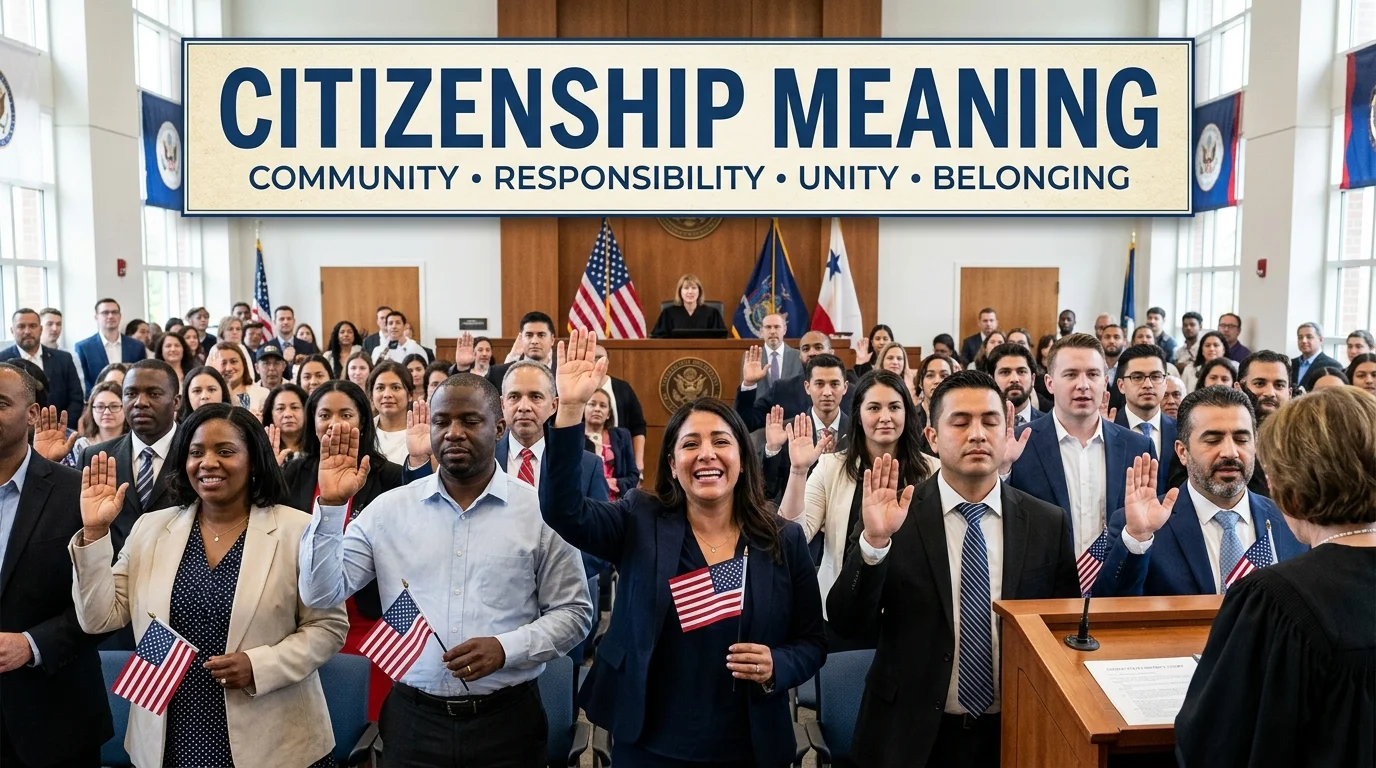
National Citizenship Meaning
National citizenship refers to the legal status of being a recognized member of a particular country. A citizen has rights, responsibilities, and protections under the laws of that nation.
Citizenship typically grants a person the right to:
Live permanently in a country
Vote in elections (where applicable)
Obtain a passport
Receive legal protection from the government
Access certain public services
Example
A person born in Canada who is legally recognized by the Canadian government is a citizen of Canada and holds Canadian citizenship.
National citizenship creates a formal legal relationship between an individual and a country.
Citizenship Example
Citizenship can be understood through everyday examples.
Example 1
A person born in the United States who holds a U.S. passport is a U.S. citizen.
Example 2
Someone who immigrates to Australia and successfully completes the naturalization process becomes an Australian citizen.
Example 3
A child born to citizens of a country may automatically receive citizenship through their parents, depending on national laws.
These examples show how citizenship identifies a person’s official membership in a nation.
Citizenship Meaning in Application Form
On an application form, citizenship refers to the country where a person holds legal citizenship status.
When a form asks:
“Citizenship:”
It is requesting the name of the country of which you are a citizen.
Example Answers
Pakistan
United Kingdom
United States
India
Australia
Applicants should provide their legal citizenship status exactly as recognized by their government.
Citizenship Definition for Students
For students, citizenship can be defined simply as:
“Being an official member of a country and having certain rights and responsibilities there.”
Simple Examples
Citizens usually:
Follow laws
Respect others’ rights
Participate in their community
Support their country through civic responsibilities
Student-Friendly Definition
Citizenship means belonging to a country and being recognized as one of its members.
Citizenship Meaning in Law
In law, citizenship is the legal relationship between an individual and a state.
This legal status gives a person specific rights and obligations established by national law.
Legal citizenship may be acquired through:
Birth
Descent from parents
Naturalization
Marriage (in some jurisdictions)
Special government grants
Citizenship laws vary from country to country, but they generally determine who belongs to the nation and what legal protections apply.
Citizenship Meaning in English
In English, citizenship means:
“The status of being a citizen of a particular country.”
Simple Definition
Citizenship = Official membership in a country.
Example Sentence
“She obtained citizenship after living in the country for several years.”
“Citizenship comes with both rights and responsibilities.”
The term is commonly used in legal, educational, governmental, and immigration contexts.
Citizenship Meaning Passport
A passport is often proof of a person’s citizenship.
Relationship Between Citizenship and Passport
Citizenship is a legal status.
A passport is an official travel document issued to citizens.
For example:
A Pakistani passport generally indicates that the holder is a citizen of Pakistan.
However, citizenship and passports are not exactly the same thing:
Citizenship = Legal membership in a country.
Passport = Document that proves identity and citizenship for international travel.
Nationality and Citizenship Meaning
Although the terms are often used interchangeably, nationality and citizenship can have slightly different meanings.
| Nationality | Citizenship |
|---|---|
| Connection to a nation by birth, origin, or heritage | Legal status granted by a country |
| Often describes national identity | Focuses on legal rights and obligations |
| May relate to ethnic or cultural ties | Primarily a legal concept |
Example
A person may have the nationality of a country through birth while obtaining citizenship through naturalization.
In many everyday situations, however, nationality and citizenship refer to the same country and are used interchangeably on forms and official documents.
Conclusion
Citizenship is the legal status of being a recognized member of a country. It provides individuals with rights, protections, and responsibilities under national law. Whether discussed in application forms, passports, education, or legal systems, citizenship represents an important connection between a person and a nation. Understanding the difference between citizenship and nationality can also help clarify many immigration, travel, and legal matters.

What Does “Citizenship Meaning” Mean in chat or Text?
Simple Definition
Citizenship is the legal status of belonging to a particular country, giving a person certain rights, privileges, and responsibilities. A citizen is recognized by the government as a legal member of the nation, which allows participation in society and access to protection under the law.
Example:
A person born in the United States automatically has U.S. citizenship, which allows them to vote, work, and live in the country legally.
Meaning Based on Context
Legal context: Citizenship determines your rights, duties, and protections under the law of a country.
Social context: It can represent your identity, culture, and belonging to a nation or community.
Political context: Citizenship allows participation in democracy, like voting or running for office.
Brief Origin
The term comes from the Latin word “civitas”, meaning city-state or community.
Historically, it referred to members of a city with rights and duties to their state.
Over time, citizenship evolved into a national legal status, recognized in modern countries around the world.

How People Use “Citizenship Meaning” in Real Life Conservations
Platforms
Texting / WhatsApp: “I finally got my citizenship certificate!”
Social media: Posts celebrating naturalization or expressing pride in nationality.
Forums / Reddit: Questions about dual citizenship, immigration, or legal requirements.
Educational content: Schools, online courses, or news articles discussing citizenship rights and responsibilities.
When It’s Appropriate vs Awkward
Appropriate:
Discussing legal status, immigration, or nationality
Talking about voting, passports, or government services
Sharing personal milestones like naturalization
Awkward / Confusing:
Using “citizenship” casually to mean belonging to a club or online community (unless metaphorical)
Confusing citizenship with residency — residents may live in a country without full citizenship rights
Casual Explanation With Personal-Style Insights
Think of citizenship as your membership card to a country:
Gives you rights like voting, working, and healthcare access.
Comes with responsibilities such as obeying laws and paying taxes.
Can be automatic by birth or earned through naturalization.
Some people even hold dual or multiple citizenships, allowing them to belong legally to more than one country.
Real-Life Examples of “Citizenship Meaning” in Text Messages
Example 1:
A child born in Canada automatically receives Canadian citizenship. This grants them rights to education, healthcare, and legal protection.
Example 2:
Someone who moves to Australia and completes the legal process to become a citizen gains the same rights as those born there, including voting and applying for government jobs.
Example 3:
A person born in Germany to American parents may hold both German and U.S. citizenship, enjoying rights and responsibilities in both countries.
Example 4:
Only citizens of a country can vote in national elections. For instance, U.S. citizens can vote in presidential elections, while permanent residents cannot.
Example 5:
A U.S. citizen traveling abroad can seek help from U.S. embassies or consulates, a privilege only available to citizens.
Common Mistakes & Misunderstandings
Confusing citizenship with residency
Living in a country doesn’t automatically make you a citizen. Residency allows living legally but may limit voting rights or government access.
Assuming citizenship is permanent
Some countries allow citizenship to be revoked under certain circumstances, though it’s rare.
Thinking dual citizenship is illegal everywhere
Some countries permit dual citizenship, while others require renouncing the first nationality.
Believing citizenship gives unlimited rights
Citizenship comes with rights but also responsibilities and legal limitations. For example, you can’t break laws without consequences.
Confusing nationality with citizenship
Nationality refers to identity or origin, while citizenship is the legal recognition by a government.
Related Slangs & Abbreviations
Naturalization: Legal process of becoming a citizen.
Birthright citizenship: Citizenship granted automatically at birth.
Dual citizenship: Being a legal citizen of two countries.
Residency / Permanent resident: Living in a country without full citizenship rights.
Passport: Official document proving citizenship and enabling international travel.