
Subordinating Conjunctions: Meaning, Examples & Complete Guide
Subordinating Conjunction Meaning in English
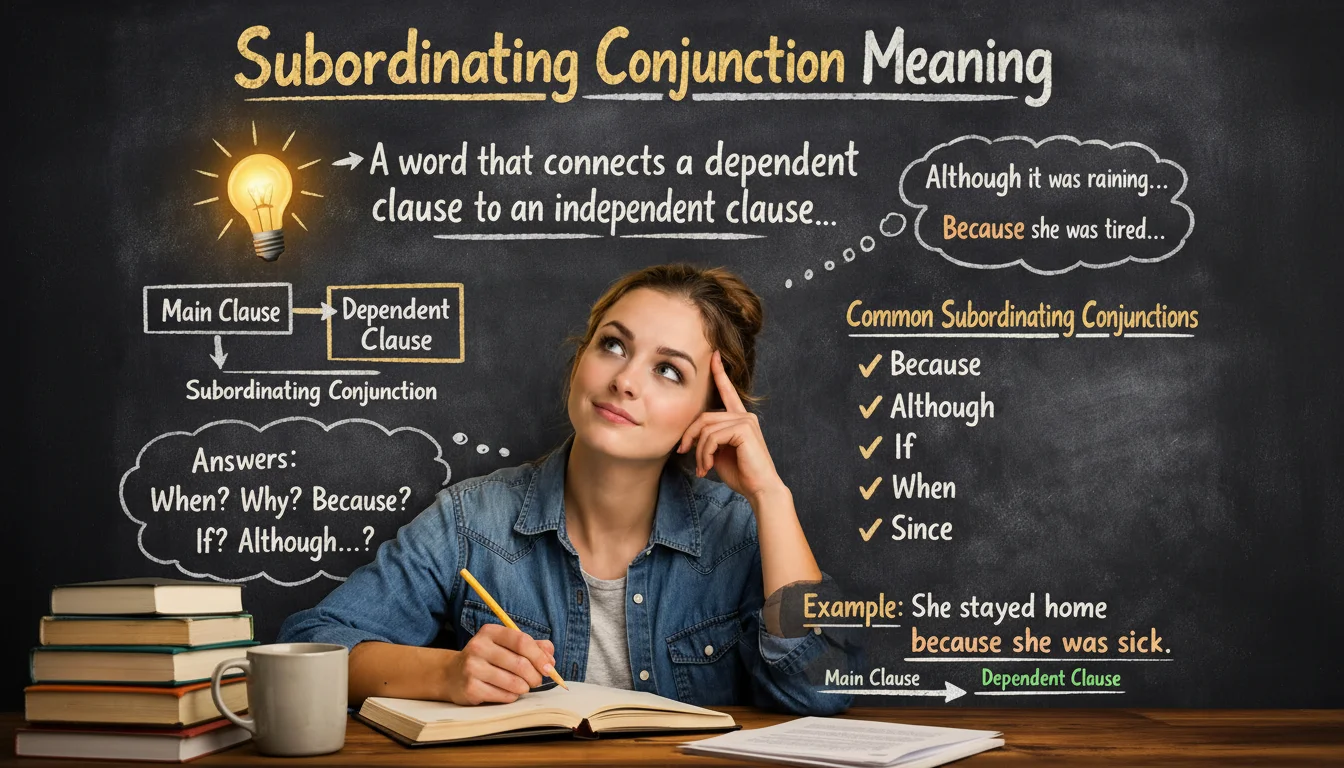
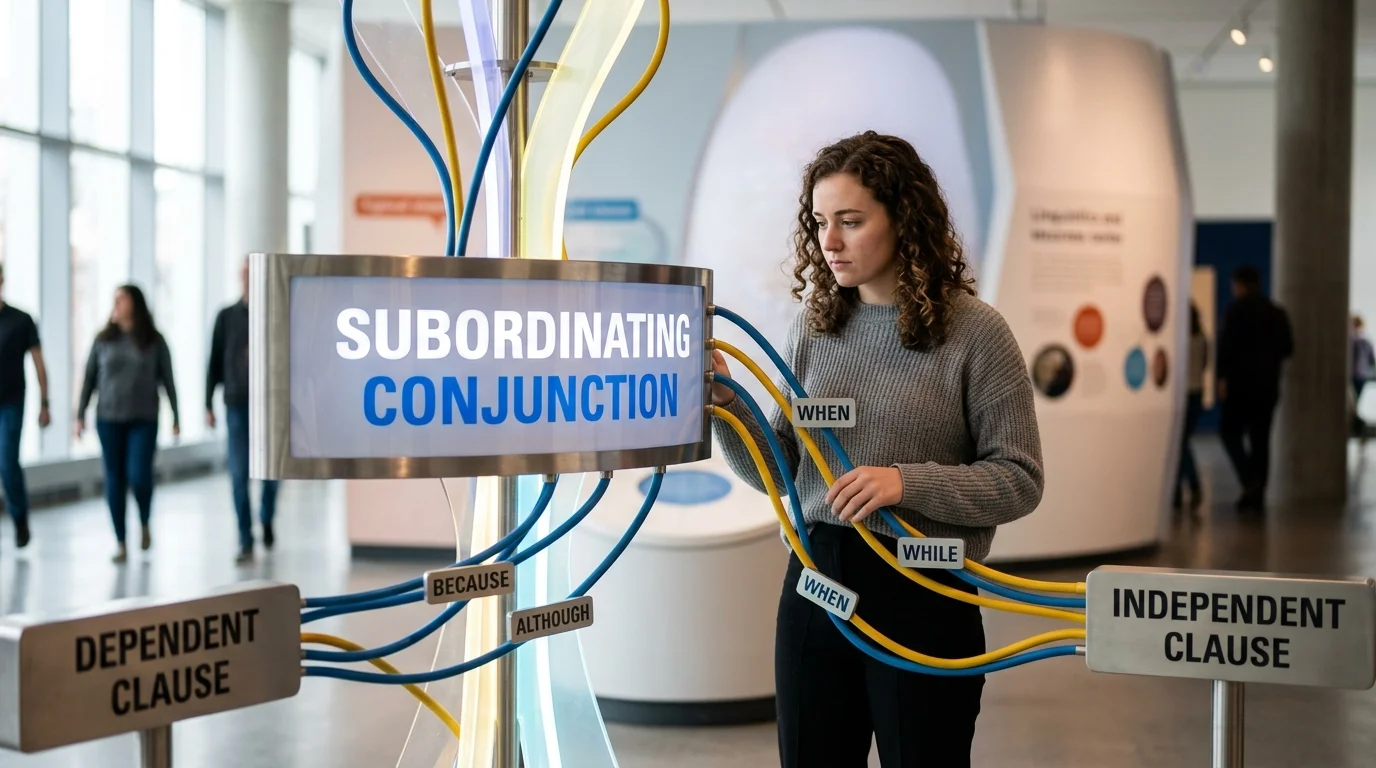
A subordinating conjunction is a word that connects a dependent (subordinate) clause to an independent clause.
It shows the relationship between the two clauses, such as:
- Time
- Cause
- Condition
- Contrast
- Purpose
- Comparison
Definition
A subordinating conjunction introduces a dependent clause that cannot stand alone as a complete sentence.
Example
- Because it was raining, we stayed indoors.
Here, because is the subordinating conjunction.
Subordinating Meaning
The word subordinating means:
Making something less important or dependent on something else.
In grammar, a subordinating conjunction makes one clause dependent on another.
Example
- “Although she was tired, she finished her homework.”
The clause “Although she was tired” depends on the main clause for complete meaning.
Subordinating Conjunctions List
Common subordinating conjunctions include:
- After
- Although
- As
- As if
- As long as
- As soon as
- Because
- Before
- Even though
- If
- In order that
- Once
- Since
- So that
- Than
- Though
- Unless
- Until
- When
- Whenever
- Where
- Whereas
- Wherever
- Whether
- While
These words help connect ideas and show relationships between clauses.
Subordinating Conjunctions Examples
Time
- After the movie ended, we went home.
- Before you leave, lock the door.
- When the bell rang, the students entered.
Cause
- Because she studied hard, she passed the exam.
- Since it was late, we left early.
Condition
- If it rains, we will stay inside.
- Unless you hurry, you’ll miss the bus.
Contrast
- Although he was tired, he continued working.
- Even though it was expensive, she bought it.
Subordinating Conjunction Examples Sentences
- Because I was hungry, I ate a sandwich.
- After we finished dinner, we watched a movie.
- Although it was cold, they went swimming.
- If you call me, I will answer.
- Since she moved away, we rarely meet.
- While I was reading, the phone rang.
- Before the meeting started, everyone arrived.
- Unless you practice, you won’t improve.
- When the teacher entered, the class became quiet.
- Though he tried hard, he lost the race.
Subordinating Conjunction Meaning for Kids
For kids, a subordinating conjunction can be explained as:
A word that joins two ideas and makes one part depend on the other.
Kid-Friendly Examples
- Because I was tired, I went to bed.
- If it rains, we will stay inside.
- When the school bell rings, class begins.
Common kid-friendly subordinating conjunctions:
- Because
- If
- When
- Before
- After
- While
100 Examples of Subordinating Conjunctions
Here are 100 common subordinating conjunction expressions and phrases:
- After
- Although
- As
- As if
- As long as
- As soon as
- As though
- Because
- Before
- Even if
- Even though
- If
- If only
- In order that
- Now that
- Once
- Provided that
- Rather than
- Since
- So that
- Than
- That
- Though
- Unless
- Until
- When
- Whenever
- Where
- Whereas
- Wherever
- Whether
- While
- Why
- Assuming that
- Given that
- Considering that
- As much as
- As far as
- In case
- Insofar as
- Lest
- Supposing
- Supposing that
- As well as
- The moment
- The minute
- The second
- Every time
- By the time
- So long as
…and many other multi-word subordinating conjunction phrases used in English.
Correlative Conjunction
Correlative conjunctions are pairs of conjunctions that work together to connect equal words, phrases, or clauses.
Common Correlative Conjunctions
- Either…or
- Neither…nor
- Both…and
- Not only…but also
- Whether…or
- Just as…so
- No sooner…than
Examples
- Either you come with us or you stay home.
- Both Ali and Ahmed passed the test.
- Not only was she smart, but also hardworking.
Difference from Subordinating Conjunctions
| Subordinating Conjunctions | Correlative Conjunctions |
|---|---|
| Join dependent and independent clauses | Join equal elements |
| Because, although, if, when | Either…or, both…and |
| Show relationships | Work in pairs |
Summary
Subordinating conjunctions are words that connect a dependent clause to an independent clause and show relationships such as time, cause, condition, contrast, and purpose. Common examples include because, if, when, after, before, although, and while. They differ from correlative conjunctions, which work in pairs such as either…or and both…and to connect equal parts of a sentence.
What Does “Subordinating Conjunction Meaning” Mean in chat or Text?
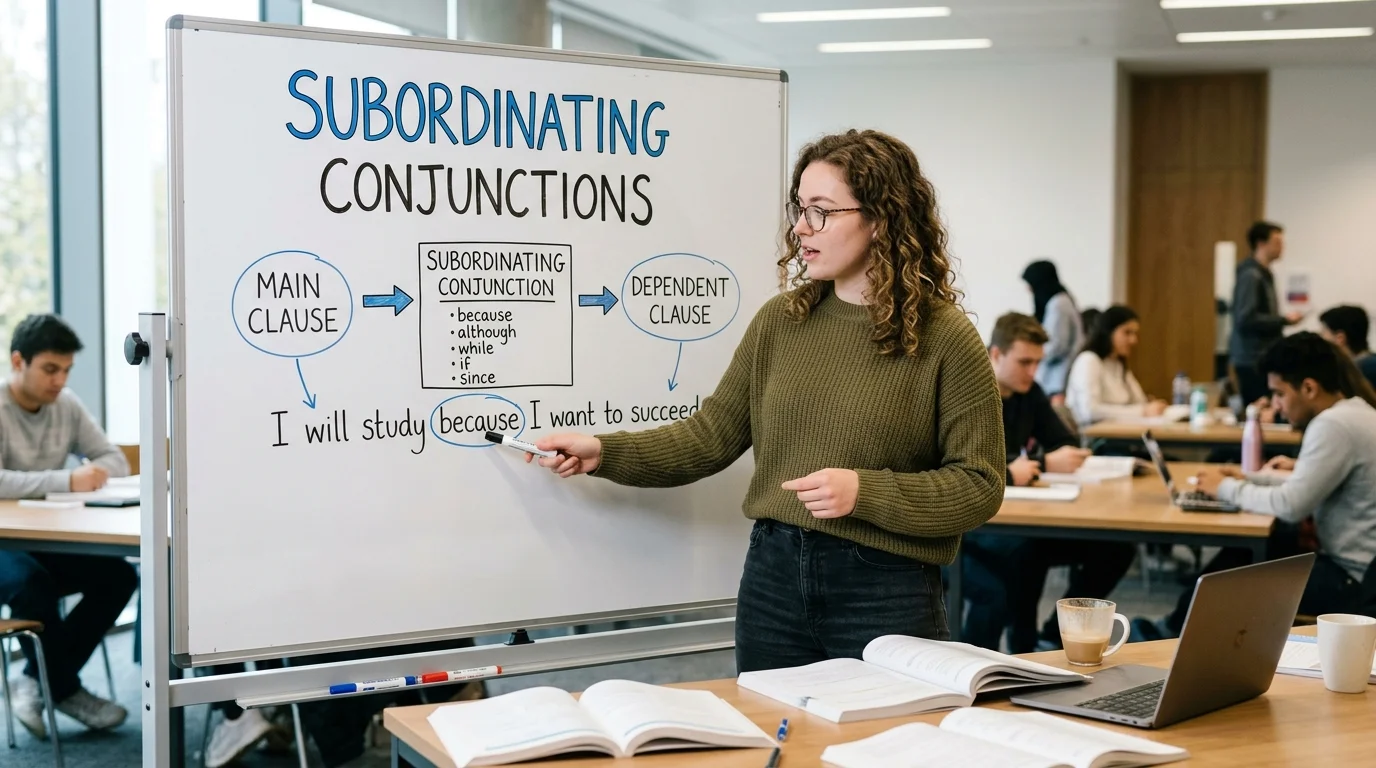
Subordinating Conjunctions are words that link a dependent (subordinate) clause to an independent clause. They show relationships between ideas, such as cause, time, contrast, condition, or purpose.
Clear definition
A subordinating conjunction is a word that connects a dependent clause to an independent clause, creating a complex sentence. Examples include because, although, since, if, when, while, and unless.
Different meanings based on context
- Cause/Effect: “Because it was raining, we stayed indoors.”
- Time: “I called her after I finished my homework.”
- Contrast: “Although he was tired, he continued working.”
- Condition: “If it rains, we’ll cancel the picnic.”
Brief origin/history
Subordinating conjunctions come from traditional English grammar rules, but they’ve been used for centuries to make writing clearer, more logical, and connected. In online writing or chat, they sometimes appear in longer, descriptive posts to make ideas flow naturally.
How People Use “Subordinatig Conjunction Meaning” in Real Conversations
Understanding Subordinating Conjunction Meaning isn’t just for grammar lessons—people discuss it in multiple contexts.
Platforms
- Texting/Chat: Explaining homework or helping a friend with grammar questions
- Instagram/TikTok: Educational posts or “learn English” content
- Discord/Forums: Language-learning servers, writing communities, or discussion threads
- Group chats: Sharing tips or correcting sentences casually
When it’s appropriate vs awkward
Appropriate:
- “Use a subordinating conjunction to link your ideas clearly.”
- “Because, although, and since are examples of subordinating conjunctions.”
- “I learned subordinating conjunctions in class today—they help sentences flow.”
Awkward or incorrect:
- Using “subordinating conjunction” to describe unrelated writing tools
- Overexplaining it in casual chat where grammar isn’t relevant
- Mislabeling coordinating conjunctions (like and, but) as subordinating
Casual explanations with personal-style insights
Friends often say: “It’s basically a word that connects two ideas, like ‘because’ or ‘although.’ Makes your sentences sound smarter.” It’s a relatable way to explain the term without being too formal.
Real-Life Examples of “Subordinating Conjunctions Meaning” in Text Messages
Seeing examples helps solidify the subordinating conjunction meaning.
Example 1:
Text: “I skipped lunch because I was busy.”
Explanation: Shows the reason for skipping lunch.
Example 2:
Text: “Although it was raining, we went for a walk.”
Explanation: Contrasts the expectation (staying inside) with reality.
Example 3:
Text: “If you finish your homework, we can watch a movie.”
Explanation: Shows a condition that must be met.
Example 4:
Text: “Call me when you arrive.”
Explanation: Shows timing for the action.
Example 5:
Text: “Since you’re free, let’s go grab coffee.”
Explanation: Provides reason for the suggestion.
Common Mistakes & Misunderstandings
Even experienced writers sometimes trip up with subordinating conjunctions.
Using a dependent clause alone:
Wrong: “Because I was tired.”
Correct: “I went to bed early because I was tired.”
Overusing conjunctions:
Too many: “Although it was raining, because I was tired, we stayed home.” → confusing
Mixing subordinating and coordinating conjunctions:
Coordinating conjunctions like and, but, or join equal clauses, not dependent ones.
Texting: In casual chat, people sometimes drop subordinating conjunctions: “I stayed home it was raining”. While common, it can reduce clarity.
Related Slangs & Abbreviations
While subordinating conjunctions are grammar terms, in texting, shorthand often replaces them:
bc → because
b/c → because
tho → although / though
if u → conditionally expressing if
Using these abbreviations keeps texting quick while maintaining the meaning of subordinating conjunctions. This is especially common among Gen Z and millennial texters.