
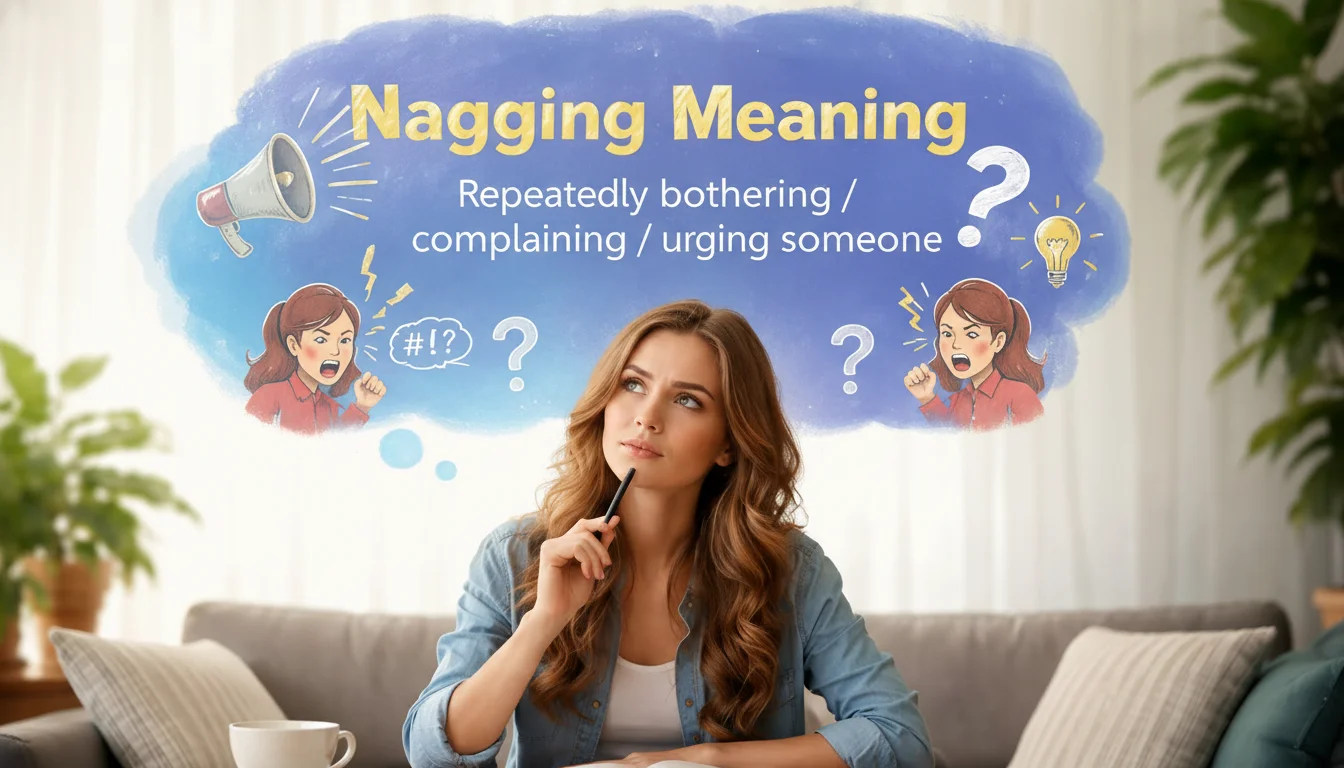

Nagging Meaning in English
Nagging means repeatedly complaining, reminding, criticizing, or urging someone to do something in an annoying or persistent way.
Definition:
Continually bothering or pressuring someone with repeated requests, complaints, or criticisms.
Examples:
- “My mom keeps nagging me to clean my room.”
- “He was nagging his friend to finish the project.”
Nagging usually has a negative connotation because it suggests excessive repetition.
Nagging Definition in a Relationship
In a relationship, nagging refers to repeatedly reminding, criticizing, or pressuring a partner about the same issue.
Common examples include:
- Repeatedly asking a partner to do household chores
- Constantly criticizing certain behaviors
- Frequently bringing up unresolved issues
- Repeated reminders about responsibilities
Example:
- “She felt that her partner was always nagging her about being late.”
Relationship experts often distinguish between healthy communication and nagging, with nagging involving repeated complaints that may create frustration or conflict.
Nagging Meaning in Russian
In Russian, nagging can be translated as:
- Пилить (Pilit’) – to constantly criticize or pester
- Придираться (Pridirat’sya) – to find fault repeatedly
- Нудить (Nudit’) – to keep complaining or pestering
Example:
- “Stop nagging me.”
- “Перестань меня пилить.”
The exact translation depends on the context.
Gagging and Nagging Meaning
Although they sound similar, gagging and nagging have completely different meanings.
| Word | Meaning |
|---|---|
| Gagging | Choking, retching, or struggling to swallow/breathe |
| Nagging | Repeatedly complaining, reminding, or pestering someone |
Examples:
- “The smell was so strong that it made him gag.”
- “She kept nagging him about his homework.”
These words are unrelated despite their similar pronunciation.
Stop Nagging Meaning
“Stop nagging” means:
“Stop repeatedly bothering, reminding, complaining, or criticizing me about the same thing.”
Example:
- “Stop nagging me about my diet.”
The phrase is often used when someone feels overwhelmed by constant reminders or criticism.
Nagging Meaning for Kids
For children, nagging can be explained simply as:
Asking or telling someone the same thing over and over again until they become annoyed.
Example:
- “Tom kept nagging his parents for a new toy.”
Simple example:
- “Please, please, please can I have it?”
- Repeating the request many times may be considered nagging.
Nagging Meaning in Business
In business, nagging can refer to repeated reminders, complaints, or requests that become excessive or irritating.
Examples:
- Constant follow-up emails
- Repeated requests for updates
- Excessive customer complaints
- Frequent reminders about deadlines
Example:
- “Employees felt the manager was nagging them about productivity targets.”
In professional settings, effective communication is generally preferred over repetitive pressure.
Nagging Meaning in French
In French, nagging is commonly translated as:
- Harceler = To pester or harass
- Rabâcher = To repeat the same thing constantly
- Faire des reproches constamment = To constantly criticize
Example:
- “She keeps nagging me.”
- “Elle n’arrête pas de me harceler.”
The appropriate translation depends on the specific situation.
Summary
Nagging means repeatedly bothering, reminding, criticizing, or pressuring someone about the same issue. It is commonly used in relationships, families, schools, and workplaces. While occasional reminders can be helpful, nagging usually implies excessive repetition that causes annoyance or frustration.

What Does “Nagging Meaning” Mean in Chat or Text?
Nagging is a behavior where someone repeatedly complains, criticizes, or reminds another person about something, often in a way that irritates them.
Clear definition
Nagging refers to repeatedly complaining, reminding, or criticizing someone, usually in a way that is perceived as annoying or persistent.
Different meanings based on context
- Everyday life: A partner reminding about chores repeatedly
- Workplace: A colleague repeatedly pointing out errors or instructions
- Parenting: Parents repeatedly reminding children about responsibilities
- Text/chat: Persistent reminders or repeated requests in messages
Brief origin/history
The word nagging comes from the Middle English word naggen, meaning to vex, annoy, or scold. Historically, it referred to constant complaints or reminders, often associated with domestic situations. Today, it’s used broadly for repeated requests or complaints in any setting.
How People Use “Nagging Meaning” in Real Conversations
Understanding Nagging Meaning helps in texting, social media, and daily life.
Platforms
- Texting/Chat: “Stop nagging me about homework”
- Instagram/TikTok: Posts or captions about relationships and humor
- Discord/Forums: Discussions about habits, routines, or gaming reminders
- Group chats: Friendly reminders or jokingly calling out someone’s persistence
Appropriate vs Awkward Usage
Appropriate:
- “She kept nagging me to finish my chores.”
- “Stop nagging—I’ll get it done soon!”
- “Parents often nag because they care about their children’s safety.”
Awkward or incorrect:
- Calling one simple reminder “nagging” when it’s a reasonable request
- Using it in professional emails or formal communication
- Overusing it in casual texting for minor things
Casual explanations with personal-style insights
Friends often say: “Nagging is like when someone keeps reminding you about something in an annoying way—but usually they mean well.” This captures the essence in a friendly, relatable way.
Real-Life Examples of “Nagging Meaning” in Text Messages
Here are realistic examples showing how nagging meaning appears in text messaging:
Example 1:
Text: “You keep asking me to send the report—stop nagging!”
Meaning: The sender feels irritated by repeated reminders.
Example 2:
Text: “Mom’s nagging about dinner again.”
Meaning: Persistent urging or repeated complaints.
Example 3:
Text: “I know you’re nagging, but I’ll pay the bills today.”
Meaning: Acknowledges repeated reminders, sometimes humorously.
Example 4:
Text: “Nagging coworkers can make deadlines stressful.”
Meaning: Repetitive complaints in a professional setting can create tension.
Example 5:
Text: “He’s nagging me about finishing my workout, but he’s right.”
Meaning: Recognizes persistence, even if it’s irritating.
These examples show that nagging meaning in text depends heavily on context and tone. While it often conveys irritation, it can also be used humorously or even positively when the reminder is important.
Common Mistakes & Misunderstandings
People often misinterpret or misuse the term nagging. Here are the most common mistakes:
Thinking nagging is always serious
Nagging can be light-hearted or playful, especially among friends or family. Not all repetition is negative.
Confusing nagging with advice
Advice is optional guidance; nagging is repetitive and often unwanted, regardless of intent.
Gender stereotypes
Both men and women nag. It is behavioral, not gendered, though social perceptions sometimes differ.
Overusing “nagging”
Calling someone a “nag” for occasional reminders exaggerates the situation. Nagging implies persistent, repeated behavior.
Assuming nagging is always verbal
Texting, emojis, or even repeated social media tags can be considered nagging if persistent.
Related Slangs & Abbreviations
Here are terms often associated with nagging, useful for context or internal linking:
Pestering – Repeatedly bothering someone
Hounding – Persistent pressure or reminders
Bothering – Annoying or disturbing behavior
Scolding – Verbal criticism, often repeated
Bugging – Informal term for irritating someone repeatedly
These related words help readers understand nagging in multiple contexts, including online chats and casual conversation.