
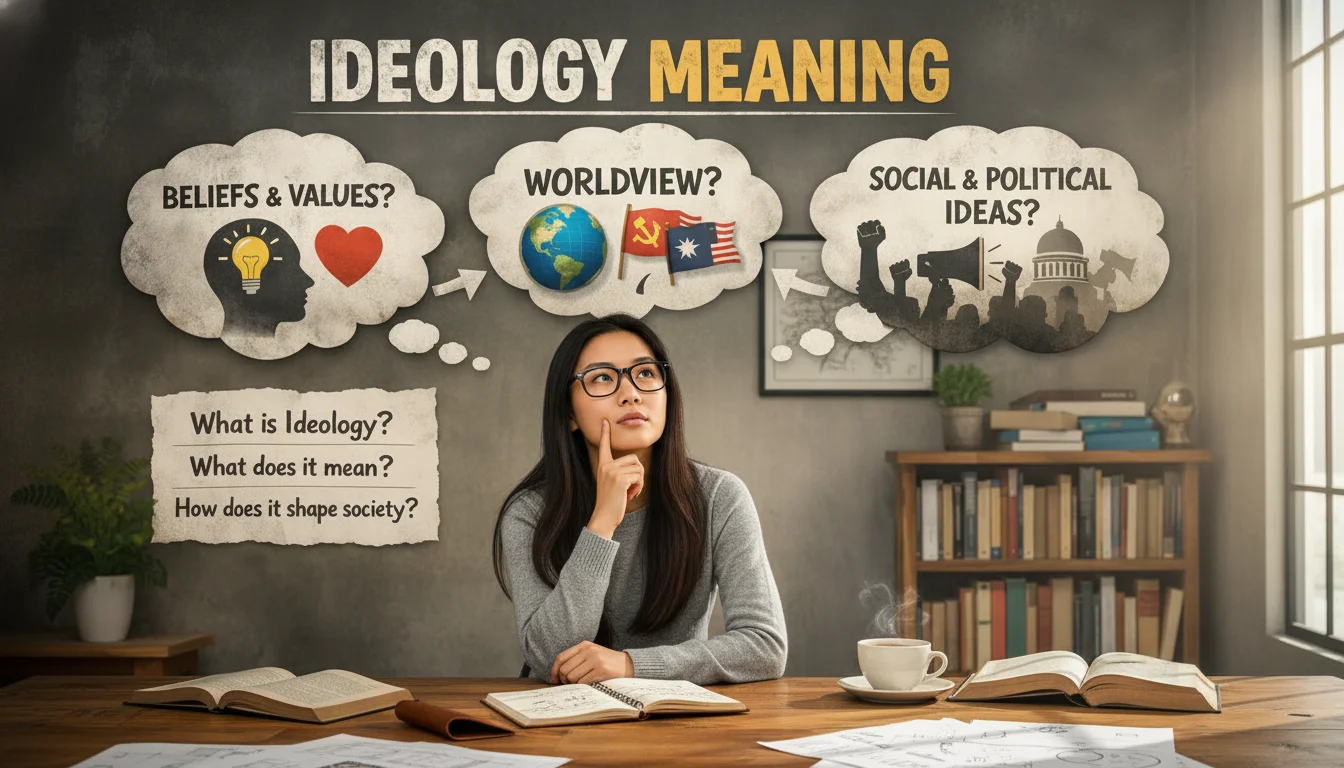


The term ideology is no longer limited to political speeches or academic books. Today, people use it in texts, online debates, tweets, comments, and casual chats. Still, many users pause and ask: what is the real ideology meaning, especially when used in chat or text?
This 2026-updated guide explains the meaning of ideology in simple words, focusing on how it’s actually used in modern conversations. If you’ve seen this word online and felt confused, you’re in the right place.

Ideology Meaning in English
An ideology is a system of beliefs, values, ideas, and principles that guides the way individuals, groups, or societies understand the world and make decisions. Ideologies influence opinions about politics, economics, religion, culture, and social issues.
In simple terms, an ideology is a set of ideas that shapes how people think and behave.
Example:
- Democracy, socialism, and capitalism are examples of ideologies that influence how governments and societies operate.
Ideologies help people interpret events, solve problems, and determine what they believe is right or wrong.
Ideology Examples
There are many different types of ideologies that influence individuals and societies.
Common ideology examples include:
- Liberalism
- Conservatism
- Socialism
- Capitalism
- Nationalism
- Environmentalism
- Feminism
- Communism
For example, a person who believes that businesses should operate with minimal government interference may support the ideology of capitalism.
Similarly, someone who prioritizes environmental protection may follow an environmentalist ideology.
Ideology Meaning and Examples
The meaning of ideology extends beyond politics. It can refer to any organized set of beliefs that guides behavior and decision-making.
Examples:
Political Ideology
Beliefs about how a country should be governed.
Religious Ideology
Beliefs based on faith and spiritual teachings.
Economic Ideology
Beliefs about wealth, markets, and economic systems.
Social Ideology
Beliefs about society, culture, and human relationships.
Example sentence:
- “Her ideology emphasizes equality and social justice.”
An ideology provides a framework through which people view and interpret the world.
Political Ideology Meaning
A political ideology is a collection of beliefs and principles about government, power, public policy, and how society should be organized.
Political ideologies influence views on:
- Taxes
- Healthcare
- Education
- Individual rights
- Economic policies
- Government authority
Examples of political ideologies include:
- Liberalism
- Conservatism
- Socialism
- Libertarianism
- Nationalism
Political parties and leaders often base their policies on specific ideological beliefs.
Ideology Meaning in Arabic
In Arabic, ideology is commonly translated as:
أيديولوجية (Ideolojiyyah)
Other related translations include:
- فكر عقائدي – Ideological thought
- منظومة فكرية – System of ideas
- مذهب فكري – Intellectual doctrine
Example:
- “Political ideology influences government decisions.”
- تؤثر الأيديولوجية السياسية على قرارات الحكومة.
The term is widely used in discussions about politics, philosophy, sociology, and history.
Personal Ideology Meaning
A personal ideology refers to an individual’s own set of beliefs, values, and principles that guide their actions and decisions.
Personal ideology may be influenced by:
- Family upbringing
- Education
- Religion
- Culture
- Life experiences
Examples of personal beliefs that form an ideology include:
- Honesty is important.
- Everyone deserves equal opportunities.
- Hard work leads to success.
A person’s personal ideology often shapes their attitudes toward relationships, work, politics, and society.
Ideology Meaning in History
In history, ideology refers to systems of ideas that have shaped societies, governments, revolutions, and historical events.
Many major historical movements were driven by ideologies, including:
- Democracy
- Nationalism
- Socialism
- Communism
- Fascism
Historians study ideologies to understand why people and governments acted in certain ways throughout history.
For example:
- The spread of nationalism influenced many independence movements around the world.
- Communist ideology played a major role in several twentieth-century political revolutions.
Ideologies often serve as powerful forces behind social and political change.
Ideology Meaning in Chinese
In Chinese, ideology is commonly translated as:
意识形态 (Yìshí Xíngtài)
Meaning:
- System of ideas
- Ideological framework
- Collective beliefs
Example:
- “Political ideology affects public policy.”
- 政治意识形态影响公共政策。
- (Zhèngzhì yìshí xíngtài yǐngxiǎng gōnggòng zhèngcè.)
The term is widely used in Chinese discussions related to politics, philosophy, sociology, education, and history.
Summary
Ideology refers to a structured set of beliefs, values, and ideas that shape how individuals and societies understand the world. Ideologies can be political, economic, religious, social, or personal. They influence decisions, behaviors, policies, and historical developments, making them an important concept in politics, history, philosophy, and everyday life.

What Does “Ideology Meaning” Mean in Chat or Text?
Clear Definition
Ideology refers to a system of ideas, beliefs, or values that shapes how people think, behave, and interpret the world. It can guide political, social, or personal decisions and often influences actions, opinions, and policies. Ideologies provide a framework for understanding society, culture, or personal identity.
Different Meanings Based on Context
- Political / Social Context:
Ideology describes a set of beliefs guiding political movements, parties, or governments.
Example: “Her ideology focuses on environmental sustainability.” - Cultural / Community Context:
Refers to shared ideas or values that influence traditions, norms, or group behavior.
Example: “The community’s ideology emphasizes cooperation and respect.” - Personal / Individual Context:
Refers to an individual’s worldview or guiding principles.
Example: “His ideology values honesty and fairness above all.” - Academic / Philosophical Context:
Used to analyze how ideas and beliefs shape society, politics, and human behavior.
Example: “Marxist ideology examines class struggles and economic systems.”
Brief History
The word ideology comes from the French “idéologie,” coined in the late 18th century by Antoine Destutt de Tracy. Originally, it meant the study of ideas, but over time it evolved to refer to systems of beliefs or doctrines that guide societies, politics, and individuals.
In 2026, ideology is widely discussed in social media debates, political discourse, education, and cultural analysis, helping people understand why individuals or groups think and act the way they do.

How People Use “Ideology Meaning” in Real Conversations
Platforms:
- Texting / WhatsApp / Messenger:
Friend: “I don’t agree with his ideology.”
Used when discussing someone’s beliefs or values. - Instagram / TikTok:
Caption: “Sharing my ideology: kindness first, always.”
Used to express personal values or principles. - Political Discussions / Forums:
“The ideology behind this policy is controversial.”
Used when analyzing politics or social systems. - Education / Academic Context:
“We studied feminist ideology in history class.”
Used when learning about belief systems and societal structures. - Casual Conversations:
“Her ideology really shapes the way she treats others.”
Used to describe personal principles or worldview.
When It’s Appropriate vs Awkward
- Appropriate:
- Discussing political or social beliefs
- Sharing personal values or guiding principles
- Academic or research analysis of systems of thought
- Awkward:
- Using it casually in unrelated contexts
- Overusing it in informal chat to sound intellectual
- Misapplying it to trivial opinions
Casual Explanation with Personal-Style Insights
Think of ideology as your personal or group “lens” for viewing the world. It’s the belief system that guides your decisions, actions, and values.
Whether it’s political, cultural, or personal, an ideology helps explain why people think and act the way they do. In casual chat, saying someone’s ideology influences their behavior is just a way of pointing out their guiding principles or worldview.
Real-Life Examples of “Ideology Meaning” in Text Messages
Here are some realistic chat-style examples to make ideology meaning clearer:
Example 1:
“Bro, this whole debate turned into ideology instead of logic.”
Meaning: The discussion became belief-driven, not fact-based.
Example 2:
“She won’t change her mind, it’s her ideology.”
Meaning: Her beliefs are deeply fixed.
Example 3:
“Algorithms feed people the same ideology again and again.”
Meaning: Online platforms reinforce one way of thinking.
Example 4:
“This movie is more ideology than entertainment.”
Meaning: The message feels preachy or agenda-driven.
Each example shows how ideology is used to explain why conversations become stuck or emotional.
Common Mistakes & Misunderstandings
Many people misunderstand the ideology meaning, especially online.
Thinking Ideology Is Only Political
Ideology exists in culture, religion, education, business, and lifestyle — not just politics.
Confusing Ideology With Opinion
An opinion can change easily.
An ideology is deeply rooted and long-term.
Using Ideology as an Insult
Calling something “ideology” doesn’t automatically make it wrong. Everyone has some ideology, even if they deny it.
Assuming Ideology Is Always Bad
Ideologies can guide positive social movements as well. The problem arises when they block dialogue.
Related Slangs & Abbreviations
If you’re reading about ideology meaning, you may also come across these related terms in chat or online discussions:
Worldview – How someone sees reality
Belief system – Organized set of beliefs
Narrative – Story shaped by ideology
Bias – Favoring one idea or group
Echo chamber – Only hearing similar views
These terms are often used together, especially in online debates and social media discussions.
FAQs
What does ideology mean?
It’s a system of ideas, beliefs, or values that shapes thought and behavior.
Is ideology only political?
No, it can be political, cultural, personal, or philosophical.
Can ideology change over time?
Yes, beliefs and guiding principles can evolve with experience and knowledge.
Why is ideology important?
It helps explain actions, decisions, and societal or cultural patterns.
Where did the term ideology come from?
From French “idéologie,” originally meaning the study of ideas, later evolving to mean belief systems.
Conclusion
Understanding the ideology meaning is not just about learning a definition — it’s about understanding how people think, argue, and make decisions, especially in today’s online world. In chats, texts, and social media conversations, ideology often explains why discussions become emotional, divided, or completely stuck.
When you recognize ideology in conversations, you stop taking every disagreement personally. You begin to see that many arguments are not about facts at all, but about deep-rooted belief systems that shape opinions long before the conversation even starts. This awareness helps you communicate more clearly, avoid pointless debates, and think more critically about the content you consume online.
