

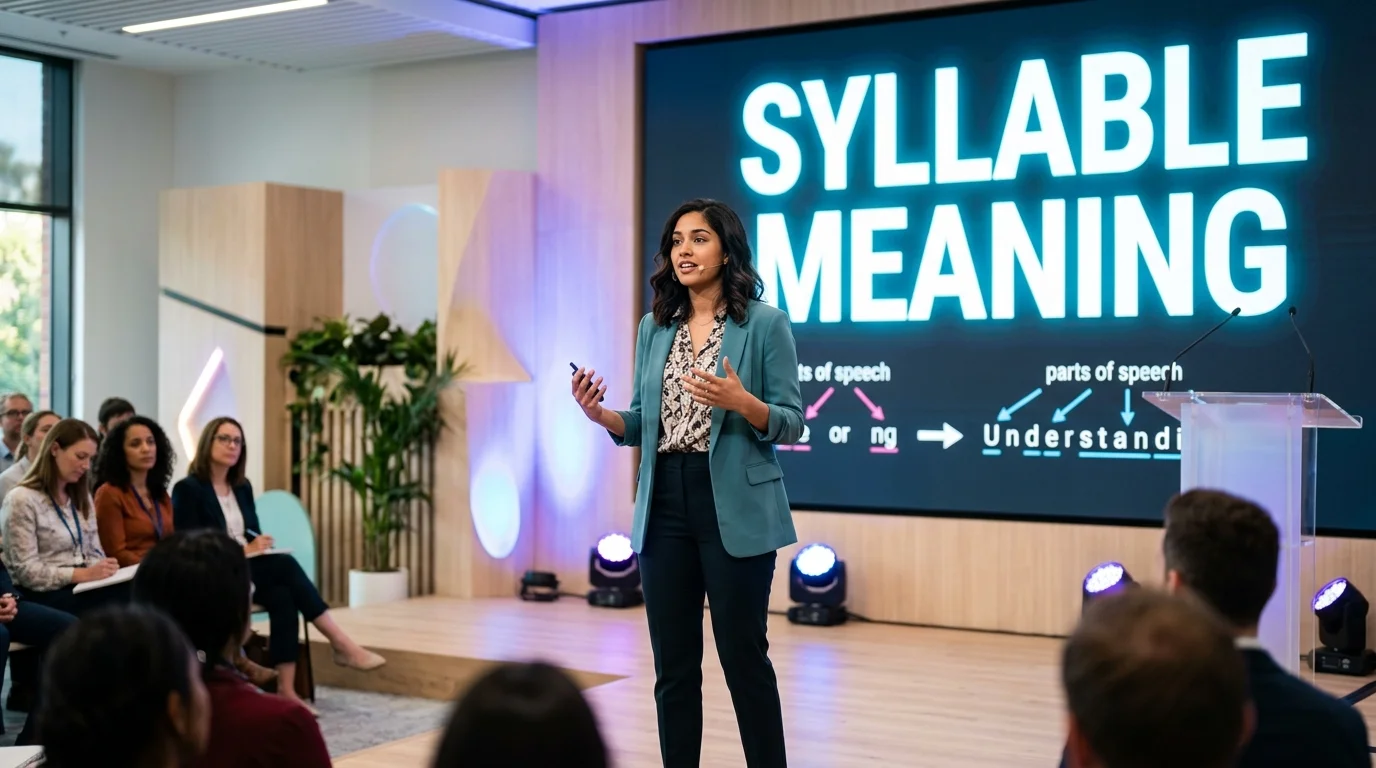
Syllable Meaning in English
A syllable is a unit of pronunciation that contains a single vowel sound and forms part of a word. Words can have one syllable or multiple syllables depending on how they are pronounced.
In simple terms, a syllable is a beat or sound unit in a word.
For example:
Cat = 1 syllable
Apple = 2 syllables
Banana = 3 syllables
When speaking, each syllable is pronounced as a separate sound unit. Understanding syllables helps improve pronunciation, spelling, reading, and language learning.
Syllables Examples
Here are some common examples of words grouped by the number of syllables they contain:
One-Syllable Words
Dog
Book
Sun
Tree
House
Two-Syllable Words
Apple
River
Pencil
Window
Happy
Three-Syllable Words
Banana
Elephant
Family
Holiday
Beautiful
Four-Syllable Words
Education
Calculator
Information
Celebration
These examples show how words can be divided into different sound units.
Syllable Meaning Example
A syllable can be understood by clapping the beats in a word.
Examples
Cat
Cat
1 syllable
Apple
Ap-ple
2 syllables
Banana
Ba-na-na
3 syllables
Computer
Com-pu-ter
3 syllables
Each separate spoken beat represents a syllable.
Syllable Meaning for Kids
For kids, a syllable can be explained as:
“A syllable is a part of a word that you can hear as one beat when you say it.”
Fun Examples
Dog = 1 clap
Rabbit = 2 claps (Rab-bit)
Butterfly = 3 claps (But-ter-fly)
A simple way for children to count syllables is to clap their hands while saying a word slowly.
This method makes learning pronunciation easier and more enjoyable.
Two Syllable Meaning
A two-syllable word contains two separate sound units or beats.
Examples
Apple (Ap-ple)
Tiger (Ti-ger)
Happy (Hap-py)
Flower (Flow-er)
Window (Win-dow)
When spoken, these words naturally break into two pronunciation parts.
Example Sentence
“The happy child ate an apple.”
Both happy and apple are two-syllable words.
3 Syllable Meaning
A three-syllable word contains three distinct sound units.
Examples
Banana (Ba-na-na)
Family (Fam-i-ly)
Elephant (El-e-phant)
Holiday (Hol-i-day)
Computer (Com-pu-ter)
Example Sentence
“The elephant walked through the forest.”
The word elephant has three syllables.
Three-syllable words are common in everyday English vocabulary.
One Syllable Meaning
A one-syllable word contains only one sound unit or beat.
Examples
Cat
Dog
Book
Tree
Ball
House
School
Example Sentence
“The dog ran fast.”
The words dog, ran, and fast each have one syllable.
One-syllable words are often among the first words children learn to read and pronounce.
Syllable Meaning in Arabic
In Arabic, the word syllable is commonly translated as:
مقطع لفظي (Maqtaʿ Lafẓī)
or
مقطع صوتي (Maqtaʿ Ṣawtī)
These terms mean:
مقطع = Segment or section
صوتي / لفظي = Sound or pronunciation
In Arabic linguistics, a syllable refers to a unit of sound within a word, similar to its meaning in English.
For example:
كتاب (Ki-tab) = 2 syllables
مدرسة (Mad-ra-sa) = 3 syllables
The concept of syllables is important in both Arabic and English pronunciation.
Summary
A syllable is a unit of pronunciation that contains a vowel sound and forms part of a word. Words may have one, two, three, or more syllables depending on how they are spoken. Learning syllables helps improve reading, spelling, speaking, and pronunciation skills. Whether you’re studying English grammar, teaching children, or learning another language, understanding syllables is an essential part of language development.
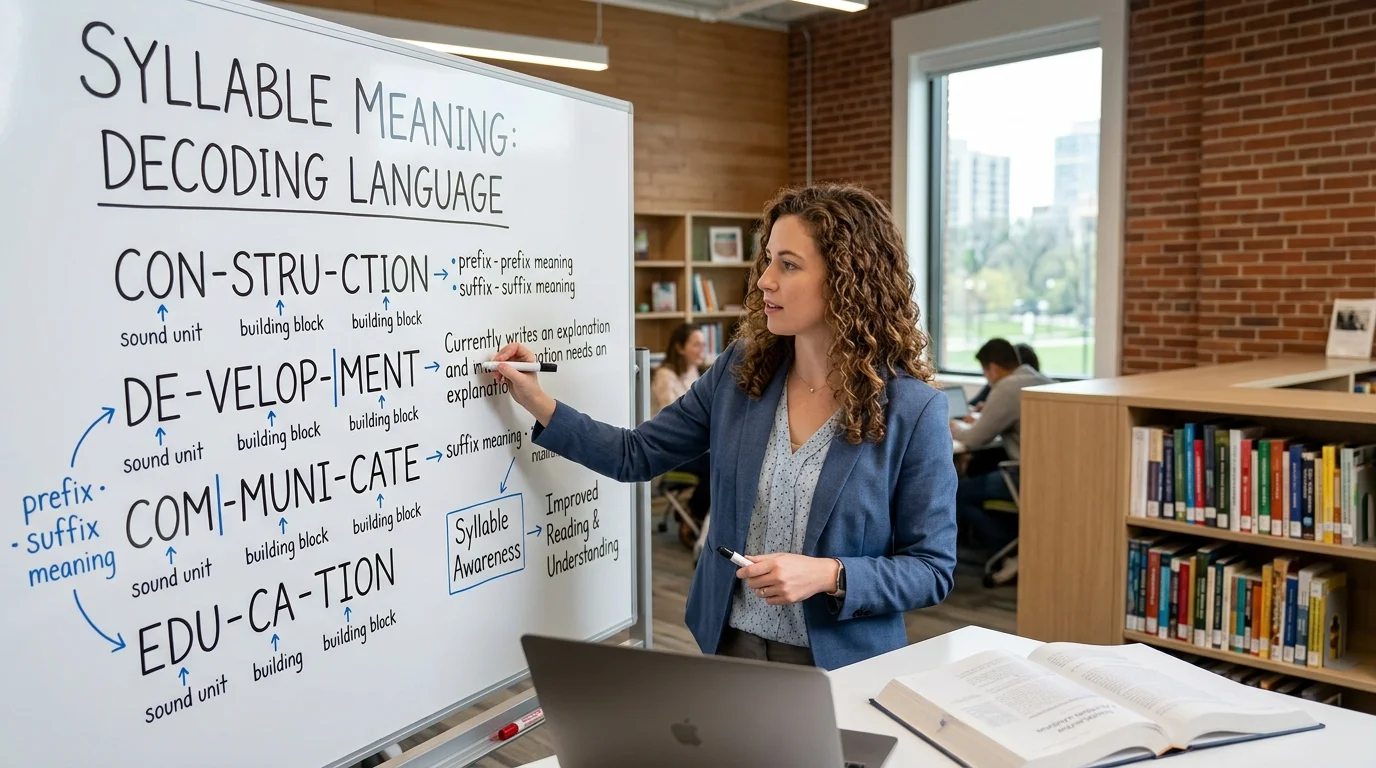
What Does “Syllable Meaning” Mean in Chat or Text?
A syllable is a unit of pronunciation containing one vowel sound, with or without surrounding consonants. Syllables are the building blocks of words and help determine how a word is spoken, stressed, and written.
Simple Definition
Syllable meaning:
A single unit of sound in a word, typically containing a vowel sound and forming the beat of the word when spoken.
Different Meanings Based on Context
In English pronunciation:
A syllable is the part of the word you emphasize when speaking.
Example: “sy-lla-ble” has three syllables.
In poetry or songwriting:
Syllables are counted to maintain rhythm and meter.
Example: Haikus use a 5-7-5 syllable pattern.
In texting or shorthand:
Rarely, people reference syllables when joking about mispronunciations or phonetics.
Example: “That word has too many syllables for me to say fast.”
Brief Origin
The word “syllable” comes from Middle English syllable, which traces back to Latin syllaba and Greek syllabē, meaning “that which is held together.”
Historically, syllables have been essential in language instruction, poetry, and linguistics.
Key takeaway: In any context, a syllable represents a single beat or sound unit in a word.

How People Use “Syllable Meaning” in Real Conversations
While “syllable” is more academic than slang, it appears in casual speech, education, and online discussions.
Common Platforms Where “Syllable” Appears
Textbooks and academic lessons: Most common in language classes.
Text messages between students: Often jokingly to describe word difficulty.
Social media: Used in posts about pronunciation or learning English.
Language learning apps and chats: People often discuss syllables when learning new words.
Appropriate vs. Awkward Usage
Appropriate:
“This word has four syllables, so pronounce it slowly.”
“Counting syllables helps me with my rap lyrics.”
“Try breaking the word into syllables to spell it correctly.”
Awkward:
Using “syllable” unnecessarily in casual chat where “word” or “sound” would suffice.
Overexplaining minor details about pronunciation in informal conversation.
Insight: Understanding syllables improves clarity in speech, spelling, and reading comprehension, even in everyday texting.
Real-Life Examples of “Syllable Meaning” in Text Messages
Here are some realistic chat-style examples of syllable meaning in text:
Example 1:
Text: “Can you break this word into syllables for me?”
Explanation: The sender wants to know how to divide the word for easier pronunciation.
Example 2:
Text: “This poem has a perfect 5-7-5 syllable pattern!”
Explanation: Refers to counting syllables for a haiku or structured verse.
Example 3:
Text: “Stop using big words; too many syllables.”
Explanation: Playful criticism about complicated words with multiple syllables.
Example 4:
Text: “Each syllable should be clear when you pronounce the word.”
Explanation: Instructional tip about pronunciation.
Example 5:
Text: “I’m tripping over this word because it has five syllables.”
Explanation: Shows how multiple syllables can make pronunciation tricky.
Key insight: Syllables are useful for pronunciation, rhythm, and learning new words. They are often discussed in both academic and casual contexts.
Common Mistakes & Misunderstandings
Even though the concept of syllables is simple, many people make errors when counting or using them. Here are the most common mistakes:
Confusing Letters with Syllables
Example: The word “through” has 7 letters but only 1 syllable.
Tip: Focus on the sound of the word when spoken, not the spelling.
Miscounting Syllables in Compound Words
Example: “Basketball” has 2 syllables (bas-ketball), not three.
Tip: Say the word slowly and listen for distinct beats.
Ignoring Stressed vs. Unstressed Syllables
Example: In the word “banana,” the middle syllable is stressed: ba-NA-na.
Tip: Identify the stressed syllable to pronounce words correctly.
Overcomplicating Simple Words
Example: “Apple” has 2 syllables (ap-ple), not three.
Tip: Break words into sounds naturally, without forcing extra divisions.
Assuming All Vowels Equal a Syllable
Example: “Bake” has 1 syllable, even though it has two vowels.
Tip: Listen to the vowel sounds, not the letters themselves.
Related Slangs & Abbreviations
Understanding syllable meaning becomes easier when you know related terms:
Morpheme: The smallest unit of meaning in a word.
Phoneme: The smallest unit of sound in a language.
Accent / Stress: Emphasis on a syllable in a word.
Beat / Meter: Rhythm in poetry or music determined by syllables.
Chunking: Breaking words into smaller, manageable units for easier reading.
Internal linking suggestion: You can link to articles about “phoneme meaning,” “stress in words,” or “syllable counting for beginners.”